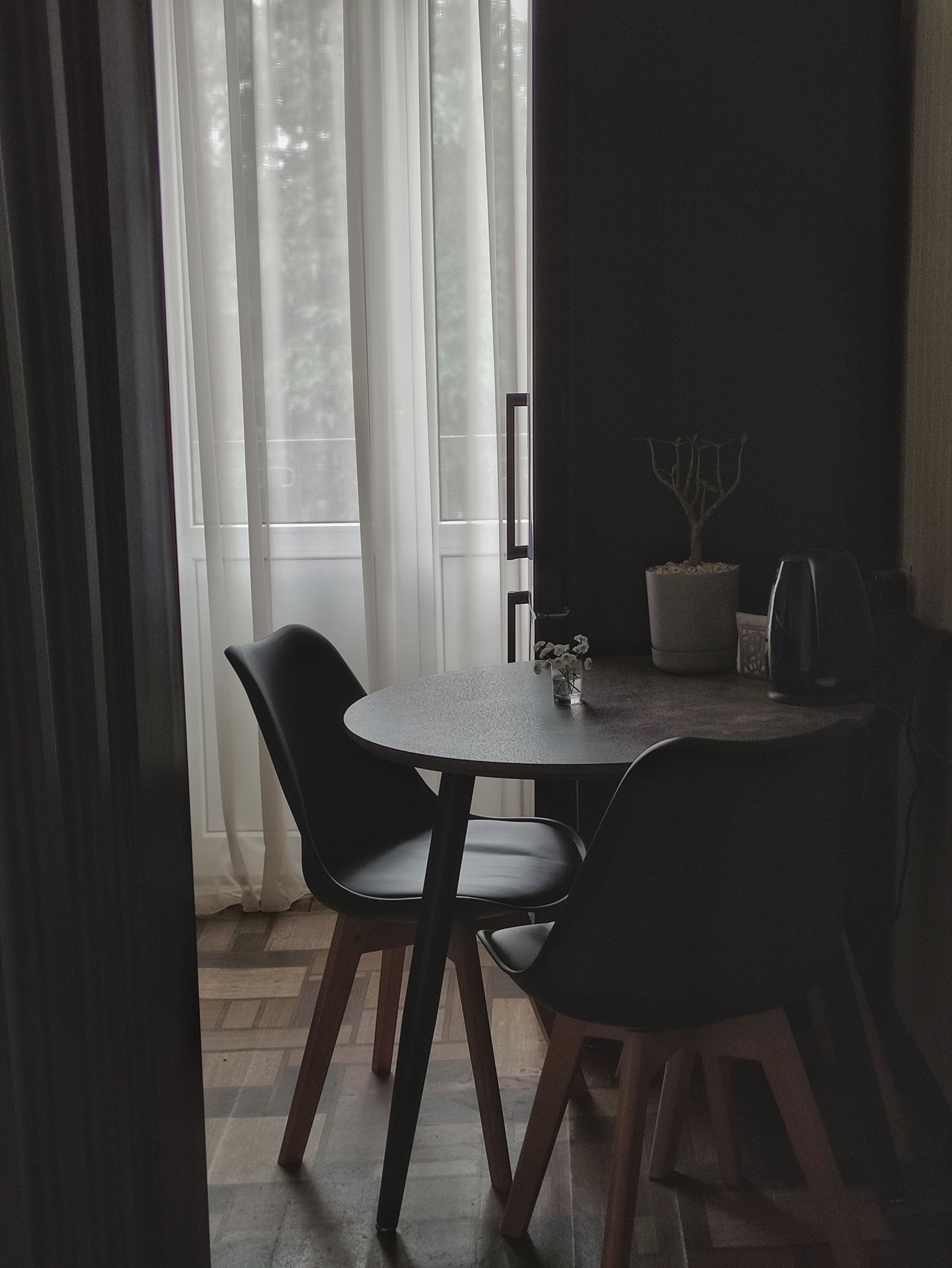
A bedroom can fit the bed perfectly and still leave nowhere sensible for a book, a glass of water or the glasses you reach for first thing in the morning. Squeezing in a standard nightstand often makes the problem worse: a drawer catches the bedding, a door cannot open fully, or the route around the bed turns into a sideways shuffle.
The answer does not have to be a smaller version of the same cabinet. These small bedroom nightstand alternatives include wall-mounted surfaces, pieces you may already own and options that attach to the bed itself. Start with what you actually need beside you, then choose the smallest arrangement that supports that routine.
This article contains affiliate links. If you buy through them, we may earn a commission at no extra cost to you. As an Amazon Associate I earn from qualifying purchases. Product links below are marked as paid links.
Before choosing: measure the space you use, not just the gap
Measure the width beside the bed, the distance from the wall to the edge of the route you walk through, and the height of your mattress with its usual bedding. Include the bed frame, baseboards and anything else that projects into the gap. A narrow tabletop can still have legs or a base that stick out farther.
Then sit and lie in your normal sleeping position. Check where you can comfortably reach without twisting or leaning over an edge. A surface around mattress height is a useful starting point, but your comfortable reach matters more than matching a showroom measurement.
- For a phone and glasses: a small shelf or bedside pocket may be enough.
- For water and a book: choose a firm, level surface with room to set things down securely.
- For several bedtime essentials: look for a lower shelf, drawer or nearby shared storage rather than expanding the tabletop indefinitely.
Mark a possible furniture footprint with painter’s tape, testing it on your flooring first. Walk past it and open nearby doors before buying. This quick check often tells you more than a photograph of the piece.
1. Use a shallow floating shelf to free the floor
A compact wall shelf is a good starting point when the bed leaves enough shoulder room but almost no space for furniture legs. It provides a landing spot for a phone, glasses and a small book while leaving the floor underneath open for cleaning.
Keep its depth tied to those essentials. A deep shelf can intrude just as much as a table, particularly when you turn to get out of bed. Position it where your hand naturally reaches, avoiding a projecting edge beside your head.
Wall construction, mounting hardware and the shelf manufacturer’s load instructions determine what it can safely hold. A floating shelf is not automatically renter-friendly: get permission before drilling where required, and do not assume adhesive strips are a substitute for specified fixings.
Best for: a minimal bedside routine and a wall that can accept a properly installed shelf.
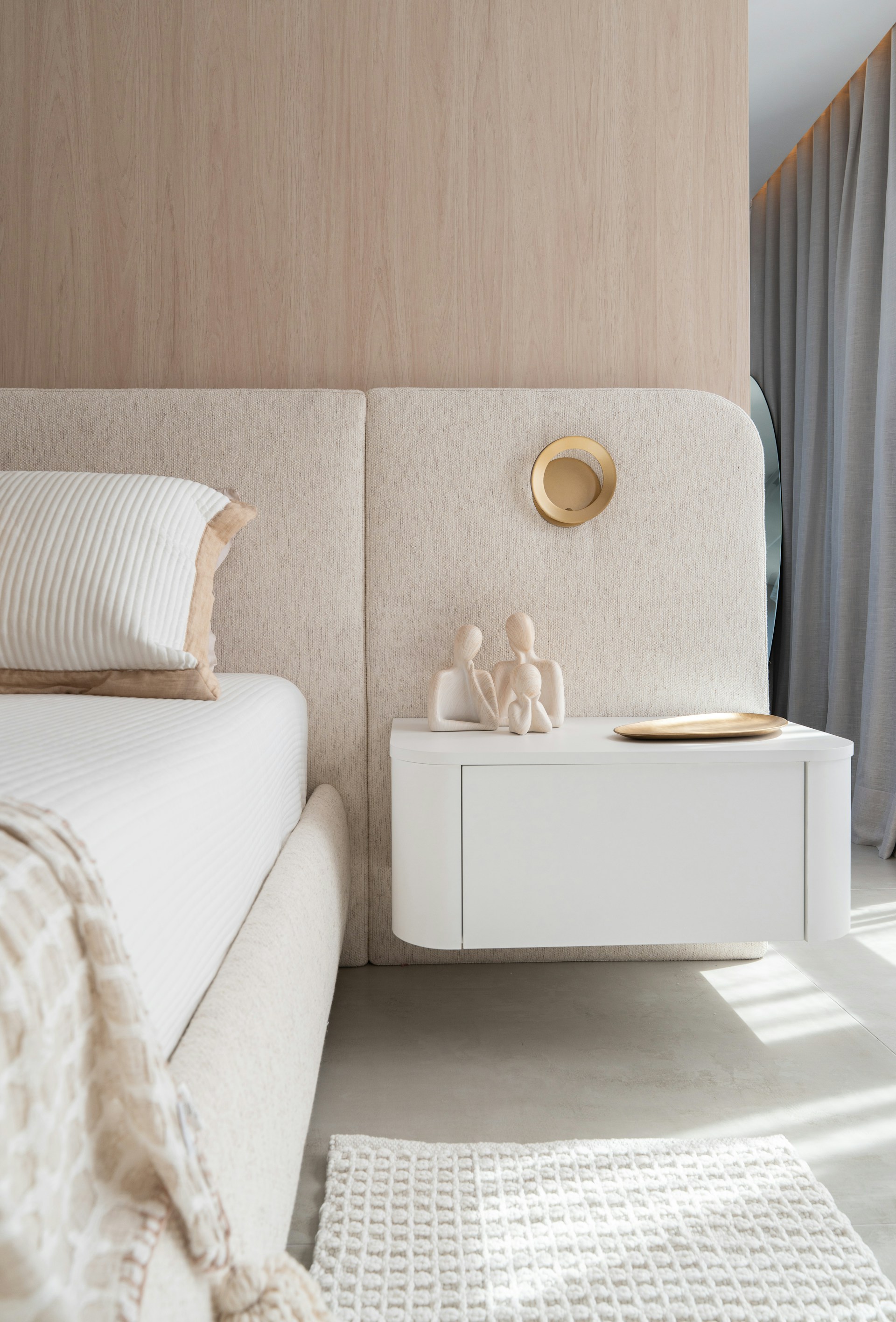
A wall-mounted bedside unit leaves the floor open; a simpler shallow shelf can apply the same idea in a tighter space. Photo by Caroline Badran on Unsplash.
2. Clip a bedside shelf onto a compatible bed frame
If you cannot drill, a clamp-on bed shelf can provide a small surface without adding another freestanding piece. It works particularly well when the problem is floor space rather than a lack of storage elsewhere in the bedroom.
The important word is compatible. Check the rail shape, thickness and access for the clamp before ordering. Upholstered sides, rounded rails and solid platform bases may need a different design, and a shelf that slides beneath a mattress is not interchangeable with a clamp-on model.
One example to compare is the BedShelfie CableCatch bedside shelf in black on Amazon (paid link). This is a bed-mounted shelf rather than a wall shelf; check the selected model’s mounting requirements against your bed. We have not personally tested it.
Once installed according to its instructions, check that the shelf is secure before putting anything on it. Keep essentials light and within its stated limits; it should never serve as a handhold for getting out of bed.
Best for: a compatible exposed bed rail and a no-drill setup.
3. Borrow a small, flat-topped stool
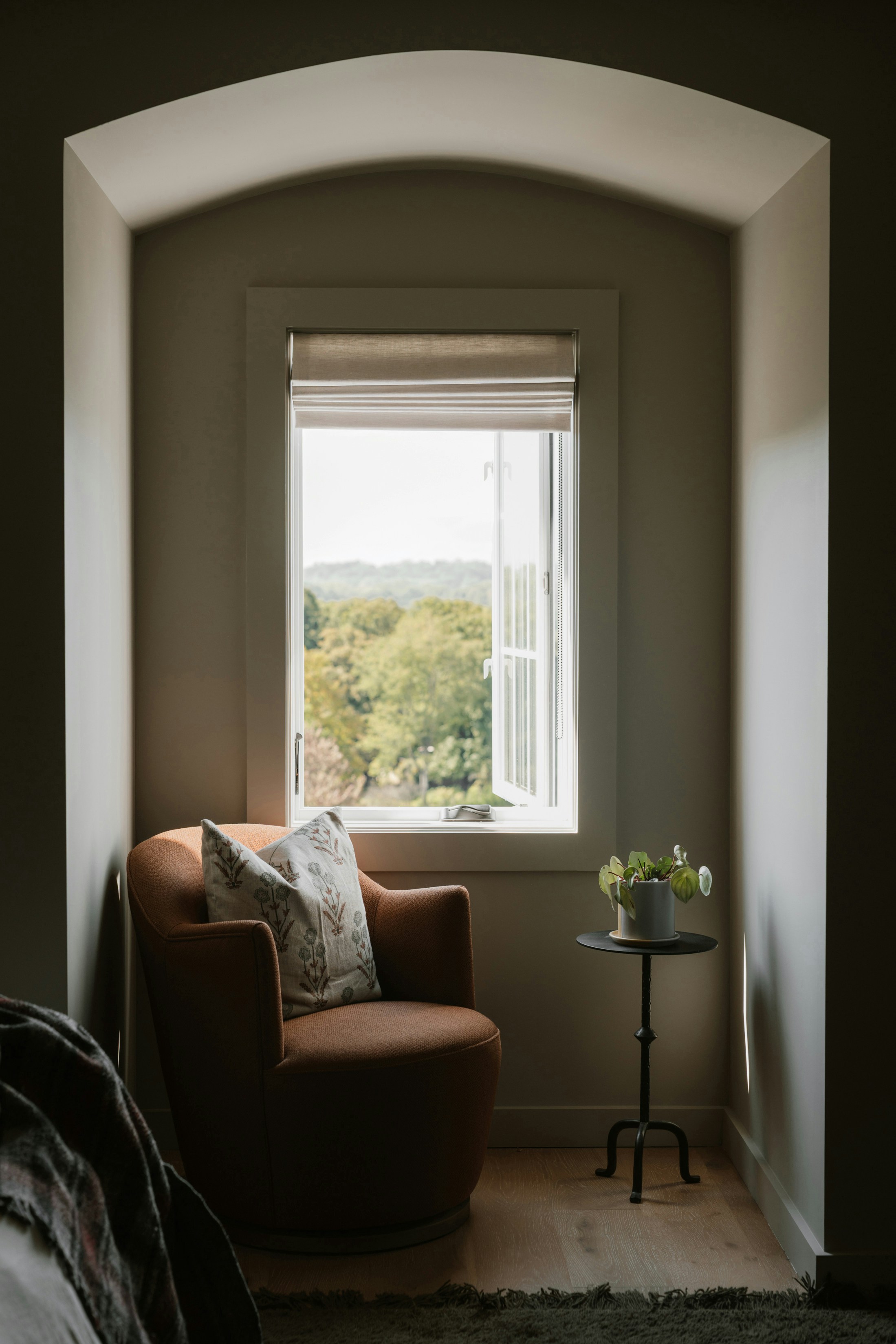
A simple wooden stool can make a lovely bedside surface, especially in a room that needs a little warmth rather than another matching cabinet. Try one you already own before buying anything: a book and a small dish for glasses may be all it needs.
Choose a stable piece with a genuinely flat top. Upholstered footstools, curved seats and lightweight decorative stands are less useful when you need to set down water. Check the leg spread as well as the seat diameter, because splayed legs can catch your foot in a narrow route.
Keep styling restrained. A tall vase and a large lamp can consume the usable surface and make a small stool feel top-heavy. If it cannot accommodate the everyday essentials safely, use it for books and glasses and place drinks elsewhere.
Best for: a low-cost trial using a sturdy piece already in your home.
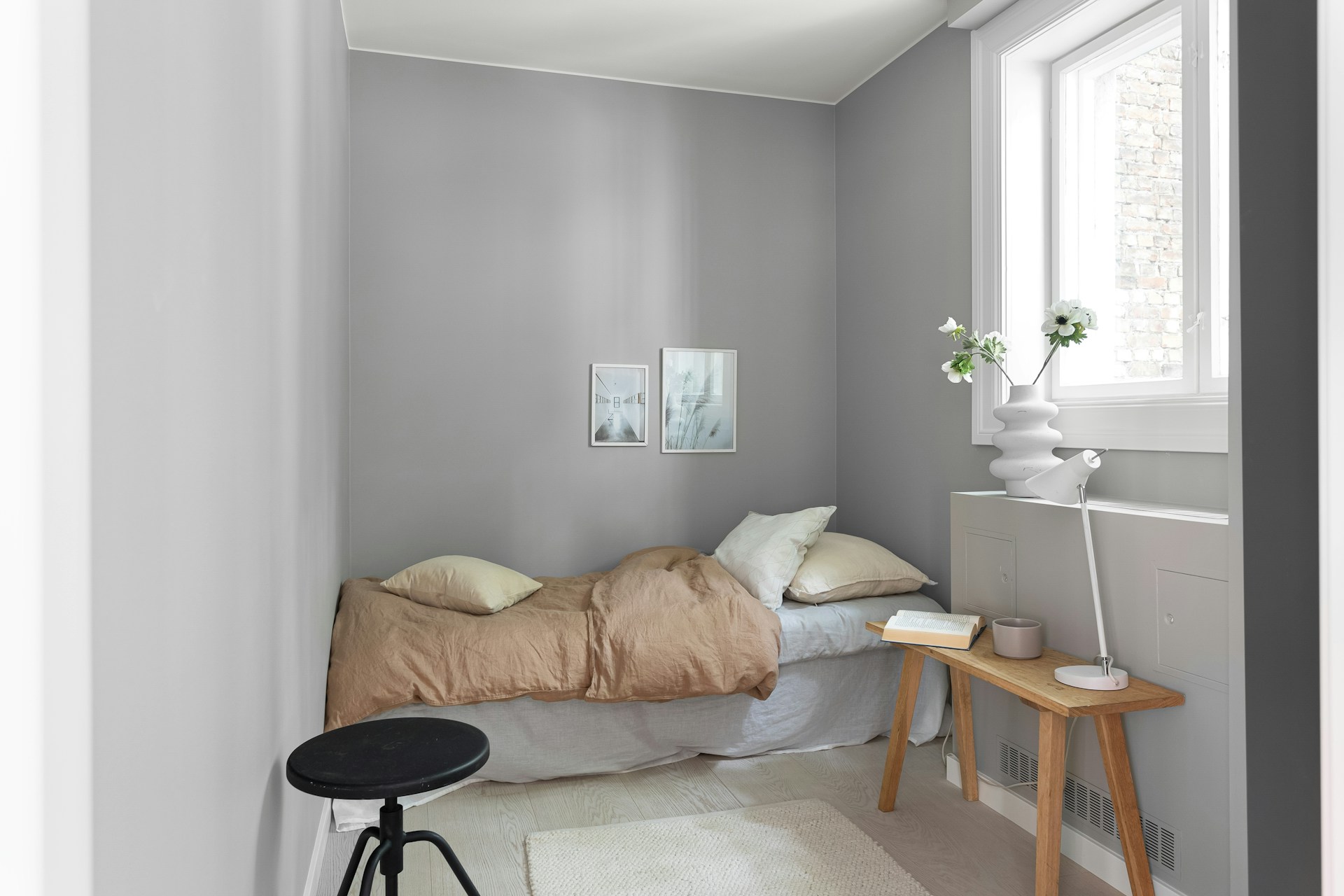
Compact furniture can take on a bedside role without a matching nightstand set. Check reach, stability and access before copying a photographed arrangement. Photo by Alex Tyson on Unsplash.
4. Try a C-shaped side table where the base can slide under
A C-shaped table moves some of its footprint beneath the bed, bringing the top closer without placing a full cabinet alongside it. It can be useful when you want a surface within easy reach but do not need drawers.
It only saves useful space if the base fits. Measure the clearance beneath the frame, check for support legs, and make sure the tabletop clears the mattress at a comfortable height. Many C-shaped tables are designed around sofa heights, so some will be too low for a taller bed.
The VASAGLE C-shaped end table in rustic brown and black on Amazon (paid link) is one option to measure against your layout. Its shape is useful only when your bed and the surrounding space allow the base and top to sit correctly. This is a researched suggestion, not a hands-on review.
Best for: beds with suitable clearance beneath the frame and room for a stable base.
5. Give a slim rolling cart a bedside role
A cart can keep several small categories together: bedtime essentials at the top, current reading in the middle and spare tissues or a sleep mask below. It is worth considering if one tiny tabletop keeps becoming a pile.
There is a trade-off: a cart can be taller and deeper than you expect. Check the overall height, including its handle, and whether you can comfortably reach into the upper basket while in bed. An open basket also works differently from a solid tabletop, so it may suit books and a glasses case better than an uncovered drinking glass.
The Pipishell three-tier rolling cart in white on Amazon (paid link) provides tiered storage and wheels. Check its current dimensions and wheel-lock arrangement before choosing it for a bedside position; we have not personally tested it. A cart that fits your room still needs to stay securely parked rather than move when you reach for something.
Use a couple of small containers to keep the shelves orderly, and avoid letting the extra capacity become an invitation to store everything beside the bed.
Best for: people who need several small storage zones and have enough room for the cart’s full footprint.
6. Use a bedside pocket when you barely need a surface
If your nighttime essentials are a paperback, glasses and a remote, a fabric bedside organizer may remove the need for a table altogether. Choose a model that attaches in a way your bed supports, and check that pockets remain accessible once the bedding is in place.
Keep the contents light so the organizer does not pull loose or sag into the route around the bed. A fabric pocket is storage, not a level drinks surface. Give water its own stable spot, and do not charge devices inside a pocket or under bedding.
This is also an easy way to discover whether you actually need a nightstand: live with a pared-back arrangement before adding furniture back into the room.
Best for: lightweight essentials when almost no floor space is available.
7. Let a nearby dresser do two jobs
Before shopping, look at the furniture already in the room. If a dresser sits within comfortable reach of one side of the bed, clearing a small landing area on its top may solve the problem with no extra footprint.
Keep that area separate from jewelry trays and everyday getting-ready clutter. A single shallow tray can signal that this part belongs to the bedside routine, but leave enough clear surface to put things down without searching for a gap.
This works only if the dresser is reachable without an awkward stretch and its drawers can open properly. Do not move a heavy dresser into a poor position just to make it serve two purposes. Follow the manufacturer’s anchoring instructions wherever it is placed.
Best for: rooms where an existing dresser already sits in a useful position.
8. Turn an existing wall niche into a bedside landing spot
An alcove, recessed ledge or built-in shelf beside the bed can be more useful than adding another object in front of it. If your room already has one, start by removing decorative clutter and keeping just the essentials nearest your sleeping position.
Use a small, wipeable tray to define the area if the surface allows, and check that reaching it feels easy when you are lying down. A niche that looks attractive from the doorway may still be too high or too far behind the pillow to work at night.
This suggestion is about using an existing feature. Cutting a new recess into a wall is a different project that requires checking the construction and services inside it.
Best for: bedrooms with a usable existing recess or built-in ledge beside the bed.
9. Choose different solutions on the two sides of the bed
A pair of matching nightstands is optional. One person may have space for a stool while the other needs a wall shelf or bedside pocket. Treat each side according to its available room and the way it is used.
Make the arrangement feel intentional with one shared detail: similar wood tones, matching small trays or a consistent lighting finish. The pieces do not need identical dimensions to belong in the same room.
For example, a small dresser can serve one side while a shelf holds just a phone and glasses on the other. The goal is a comfortable routine for both sleepers, rather than symmetry that makes the tighter side awkward.
Best for: beds positioned off-center or bedrooms with uneven space on either side.
Make a tiny bedside setup feel finished
Once the surface works, stop before it becomes crowded. Keep only the things you reach for at night beside the bed, then add one small decorative touch if there is genuinely room.
- Separate lighting from storage where helpful. A suitably positioned reading light can release space that a large lamp base would occupy.
- Give cables a clear route. Keep cords out of walking routes and away from moving parts; leave charging devices uncovered on an appropriate surface.
- Repeat one material. A warm wood shelf can connect with a picture frame or another existing detail without buying a full furniture set.
- Keep the floor accessible. A small storage idea should not create a new obstacle between the bed and the door.
For another place to enjoy your evening book, explore our cozy reading nook ideas for small spaces. The same approach applies: start with the routine, then make room for the pieces that support it.
Common nightstand-alternative mistakes to avoid
- Buying by width alone. Include depth, leg spread, door movement and the space needed to get in and out of bed.
- Assuming every clamp fits every frame. Match the attachment method to your actual bed rather than the listing photograph.
- Choosing the smallest piece regardless of stability. A narrow but wobbly surface is a poor place for water or breakable objects.
- Using a shelf or cart as support. Bedside storage is not a substitute for equipment designed to help someone stand or transfer.
- Adding decorative objects before the essentials. Make room for the things you use, then decide whether any styling is needed.
Frequently asked questions
What can I use instead of a nightstand in a very small bedroom?
A shallow wall shelf, compatible clamp-on bed shelf or bedside pocket can work when there is almost no room on the floor. If you have a little more space, try a sturdy stool or a C-shaped table. Choose according to what you need to keep within reach, rather than the number of things a product can hold.
What is the best no-drill nightstand alternative for renters?
A freestanding stool or table avoids wall fixings. A clamp-on shelf can also work if the bed frame is compatible and its attachment method is permitted for the furniture you use. Check your rental conditions before making alterations, and do not assume a product is damage-free simply because it uses no screws.
Should a bedside surface be higher or lower than the mattress?
Start around mattress height, then check your own reach while sitting and lying down. The useful height depends on the bed, your position and the items you use. Avoid a setup that makes you stretch up, reach far down or lean across an edge to retrieve something.
Do both sides of the bed need matching nightstands?
No. Different pieces can look balanced when they share a finish, material or small accessory. It is usually more useful to give each sleeper a comfortable arrangement than to force identical furniture into unequal spaces.
Start with less, then add only what helps
A comfortable bedside setup does not need much: somewhere suitable for the things you use, lighting that works for your routine and enough space to move around the bed. Try an existing stool or clear a reachable surface first. If that reveals a need for a shelf, cart or bed-mounted tray, you will know what you are buying it to solve.
And if the bedroom is only one of your tight spots, our small entryway ideas when you have no hallway offers more ways to give everyday essentials a home without filling every available corner.
Featured photograph: Clay Banks on Unsplash. Photographs illustrate decorating ideas and do not depict the linked Amazon products.